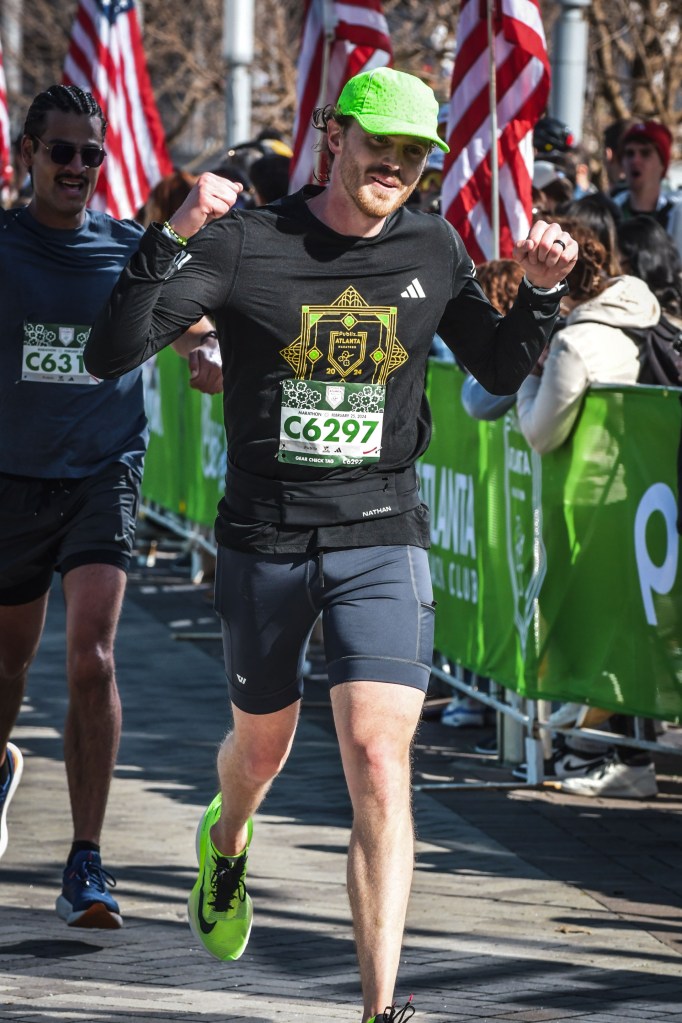
Is this even real? Two years ago, you couldn’t pay me to run more than four miles, and now I’m gearing up for my second marathon in the same year. What a journey!
From Ambitious Beginnings to 26.2 Miles
In July 2023, I set an ambitious goal: not just to train for and complete my first marathon, but to qualify for the Boston Marathon by running a sub-3-hour race. Was it crazy? Absolutely. Did I have any idea how hard that would be? Not in the slightest. But sometimes, naivety and a lack of experience can be blessings in disguise. I came pretty close to that goal, but let’s rewind a bit to where this journey really began.
My First Big Race: The Peachtree Road Race
As an Atlanta native, I’d heard about the Peachtree Road Race my whole life. It’s a big deal around here—40,000 runners braving Atlanta’s hills and notorious July heat to cover the 10k distance. Despite living in Atlanta for 30 years, I’d never run it. To get in, you need a qualifying time from a 5k or 10k that year, so I laced up some new Brooks Ghost 15s and ran a 5k in March 2023. With that qualifying time in hand, I was all set for my first Peachtree Road Race.
Race day came, and with minimal training and a large ego, I ran that 10k in about 52 minutes—an 8:15 min/mile pace. Not too shabby for a first-timer, right? I thought so, proudly posting my time on Instagram. Looking back, I can only laugh at my former self.
After Peachtree, I signed myself and my wife up for a half marathon on Thanksgiving (She absolutely crushed that race by the way). We both followed a rough 12-week plan for the half marathon before I made the switch to a 16-week marathon training plan in early November.
Entering the Marathon Era
With limited running knowledge, I Googled a “Sub 3:00 16-Week Marathon Training Plan” and jumped right in. Here’s what the plan roughly looked like:
- Monday: Easy Run (30-50 min)
- Tuesday: Intervals (e.g., 8x800m repeats)
- Wednesday: Easy Run (40-50 min)
- Thursday: Tempo Run (60 min, half easy, half at 80% effort)
- Friday: Rest Day
- Saturday: Hill Runs or a 40-minute easy run
- Sunday: Long Run (10-22 miles)
As a novice, I didn’t know what my effort levels should be or how to approach interval workouts, so I faked it till I made it. I ran in all conditions—heat, rain, frigid temperatures, even lightning—and fought through a few overuse injuries from ramping up the miles too quickly. My average weekly mileage was around 30-35, peaking at 52 miles. By race day, I felt underprepared due to injuries, but I knew I’d logged enough miles to put up a decent fight. I had spent countless hours learning about nutrition and fuel strategies, mapping out a plan for my training runs and race day. Podcasts became my best friends!
Race Day: The Ultimate Test
Race day arrived, and I was up at 5 am, fueled by coffee and nerves. My incredible wife planned to be at mile 20 for a motivational boost and at the finish line to cheer me on. As I parked near the start line, the emotions hit hard—cry number one of the day. I felt a mix of peace, accomplishment, and humility. Running had taught me to respect myself and the sport in ways I never imagined.
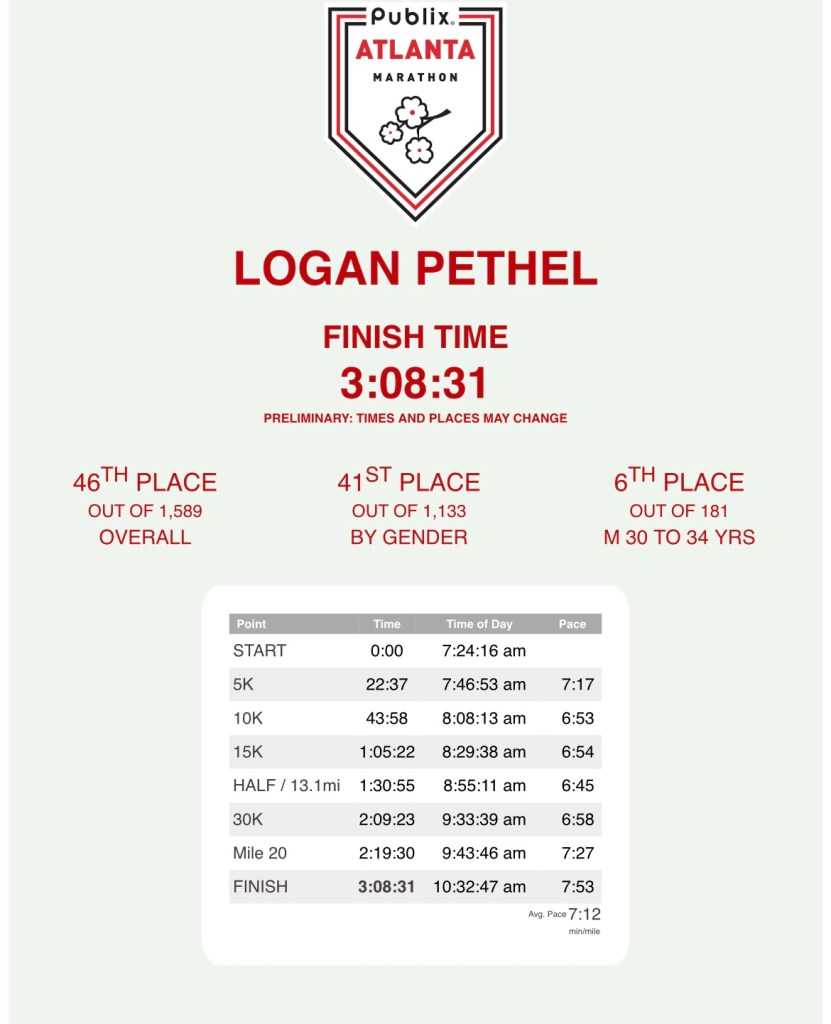
My goal was to go sub-3:00, which meant maintaining a 6:52 pace the whole race. As the gun went off, it felt like just me against the pavement. I started slower than planned due to the crowd, but picked up the pace: 7:51, 6:54, 7:02, 6:56, 6:52, 6:44. I was rolling and felt good… until the hills hit. The Atlanta Marathon course is infamous for its hills—“hills, hills, hills,” as one marathon calendar described it. I didn’t check the elevation or the percentage of Boston qualifiers when I signed up, but I still believed I could break three hours.
Around mile 18, I knew I had a shot, but by mile 19, cramps set in. My hamstrings tightened every quarter mile, and my pace started slipping. I realized I hadn’t fueled adequately late in the race, and my lack of strength training caught up with me. Miles 21 and 22 were my slowest at 7:55 and 8:09. By then, I knew I wouldn’t make my sub-3:00 goal, so I managed my cramps and tried to enjoy the last few painful miles.
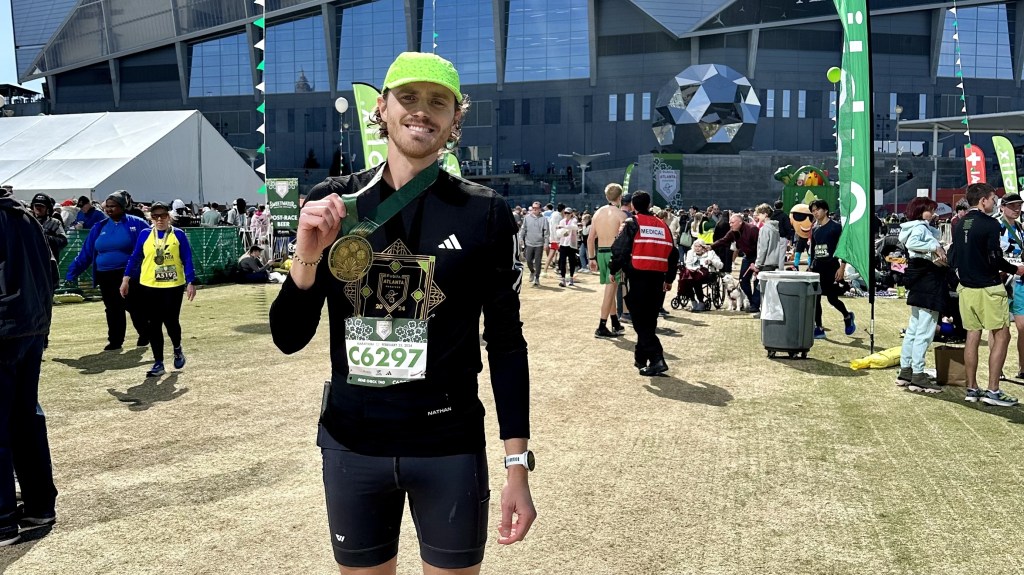
I crossed the finish line at 3:08:31. To many, that’s an unbelievable time for a first marathon. For me, it was a mix of pride and a sense of unfinished business. I gave that course everything I had, but the marathon gave me an even tougher lesson. I learned to respect the distance, and I’m hooked.
Next Up: Philadelphia 2024 and Boston 2026
Next on the agenda: the 2024 Philadelphia Marathon. Sub 3:00, here we go. And Boston 2026? I’ve already booked the hotel.
 Logan Pethel
Leave a comment